When Cities Go Quiet: The Strange Beauty of Abandoned Architecture
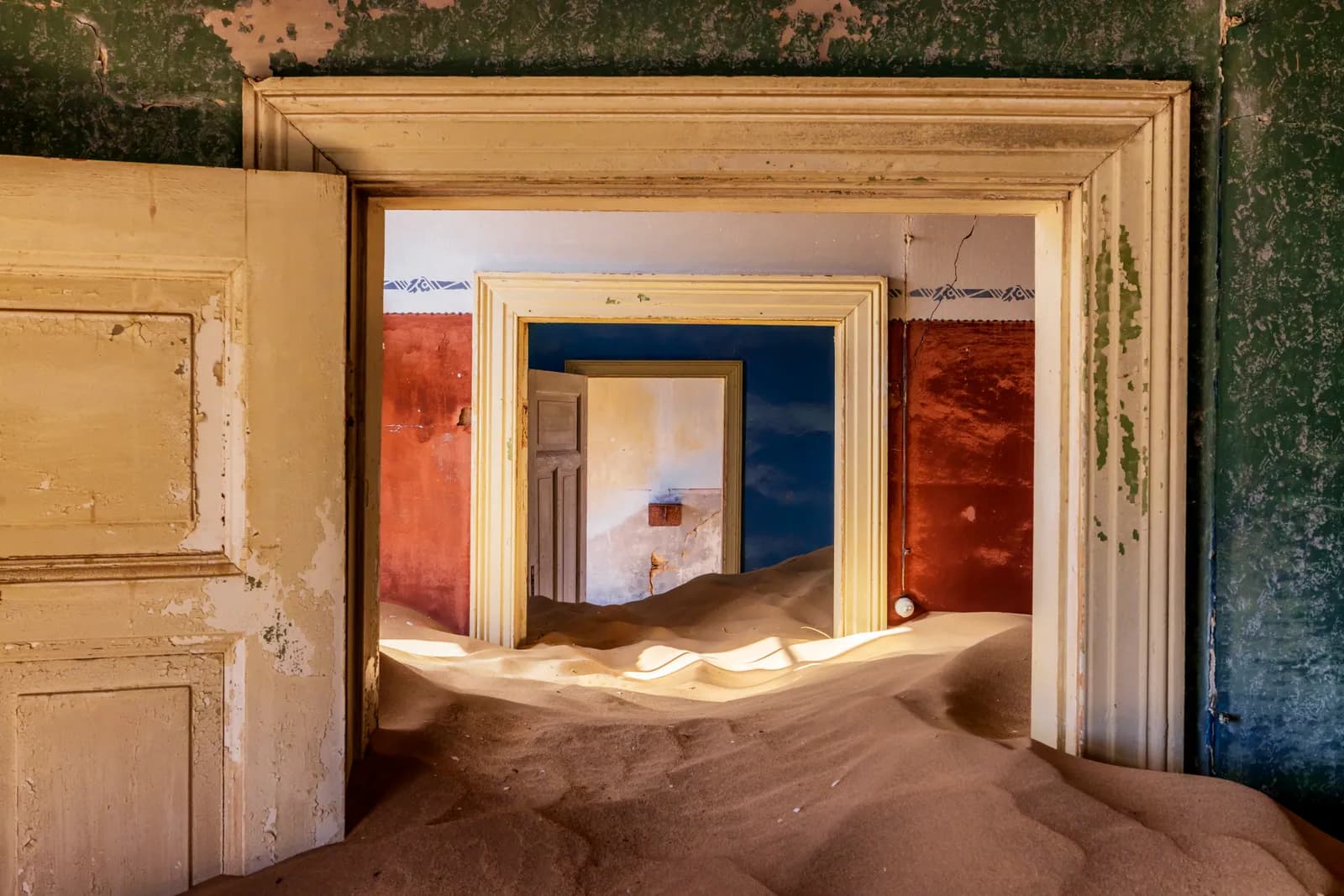
There is something unsettlingly beautiful about architecture once people disappear from it.
A house normally exists through use: doors opening and closing, furniture moving, streets filling with noise. Remove all of that and the building becomes something else entirely. Walls, staircases and entire neighbourhoods begin to feel almost sculptural. Nature moves in. Sand crosses floors. Trees break through concrete. Paint fades into new colours.
Around the world, abandoned settlements offer extraordinary examples of this transformation — places shaped by industry, disaster, migration and changing economies, then slowly returned to the landscape.
Kolmanskop, Namibia
Few abandoned places demonstrate the power of nature as dramatically as Kolmanskop.
The desert settlement grew rapidly after diamonds were discovered in the area in 1908. At its height, this unlikely town in the Namib Desert contained elegant European-style houses alongside a hospital, ballroom and other amenities created for its prosperous mining community.
Once the diamonds became harder to find, the population disappeared. By the mid-1950s the town had been abandoned.
Today, dunes move directly through its buildings. Sand fills bedrooms almost to the ceiling, climbs staircases and pours through doorways, creating interiors that appear somewhere between architecture and land art.
Pyramiden, Svalbard
Far north in the Norwegian Arctic sits an entirely different kind of ghost town.
Pyramiden was a Soviet coal-mining settlement on Svalbard, home to more than a thousand residents during its later years. Mining operations stopped in 1998, and much of the town was simply left behind.
Inside, objects remain in strangely ordinary positions: equipment in hallways, papers on walls and remnants of daily life scattered through communal buildings.
Against Svalbard's enormous mountains and empty Arctic landscape, its Soviet architecture feels almost surreal — an urban experiment stranded at the edge of the world.
Al Jazira Al Hamra, UAE
Before skyscrapers transformed the Gulf, coastal communities such as Al Jazira Al Hamra were built around fishing, pearling and trade.
The settlement in Ras Al Khaimah contains coral-and-mud-brick houses, mosques, courtyards and traditional wind towers. As the UAE's economy and infrastructure rapidly changed during the 20th century, residents gradually moved elsewhere.
What remains is an unusually intact architectural record of Emirati life before the oil era — quieter, lower and deeply connected to climate and local materials.
Villa Epecuén, Argentina
Some cities are abandoned slowly. Villa Epecuén disappeared almost overnight.
Once a popular lakeside resort in Argentina, the town was overwhelmed by flooding in 1985. Water eventually covered much of the settlement beneath several metres of the lake.
When the water began retreating decades later, the city reappeared.
The result is almost otherworldly: skeletal trees, fractured streets and buildings coated in pale mineral deposits. Instead of nature growing over architecture, here the landscape seems to have chemically rewritten it.
Tskaltubo, Georgia
Tskaltubo once represented Soviet ideas of wellness and leisure on a monumental scale.
Visitors travelled to the Georgian spa town for its mineral waters and stayed inside elaborate sanatoriums filled with sweeping staircases, decorative columns, murals and vast communal spaces.
After the collapse of the Soviet Union, many of these buildings lost their purpose and fell into decline.
Their faded grandeur is now part of their fascination. Marble floors meet broken windows; vegetation enters once-formal interiors; elaborate details survive inside rooms that have been empty for decades.
Craco, Italy
Rising dramatically above the landscape of southern Italy, Craco looks almost like an invented medieval city.
Its tightly packed stone structures, narrow streets and fortified character developed over centuries. But repeated landslides, flooding and earthquakes eventually made the town too dangerous to inhabit, forcing residents to leave.
Without contemporary additions or normal urban activity, the architecture now reads almost as a single composition — stone buildings merging into the mountain beneath them.
Humberstone, Chile
In Chile's Atacama Desert, Humberstone preserves another side of abandoned architecture: the remains of an entire industrial society.
The settlement grew around nitrate mining during the late 19th and early 20th centuries. Workers lived in company housing alongside theatres, shops and recreational spaces.
When synthetic alternatives destroyed demand for natural nitrate, the industry collapsed and the settlement eventually emptied.
The desert climate has helped preserve its wooden buildings, machinery and sun-bleached public spaces, giving Humberstone the appearance of a stage set whose actors simply walked away.
Hashima Island, Japan
From a distance, Hashima Island resembles a battleship floating off the coast of Nagasaki.
The island was intensively developed for coal mining, eventually becoming one of the world's most densely populated places. Concrete apartment blocks rose tightly beside industrial infrastructure, creating an extraordinary vertical settlement surrounded entirely by sea.
When Japan's energy economy shifted away from coal, the mine closed in the 1970s and residents departed within months.
The resulting landscape is brutal and beautiful: collapsing reinforced concrete towers, empty windows and fragments of vegetation exposed to decades of salt, wind and storms.
Pripyat, Ukraine
Perhaps no abandoned modern city feels as abruptly frozen as Pripyat.
Built near the Chernobyl Nuclear Power Plant, the Soviet city housed tens of thousands of residents before the 1986 nuclear disaster forced its evacuation.
Schools, apartment blocks, sports facilities and an amusement park were suddenly left behind.
Over the decades, trees have pushed through streets and vegetation has spread across playgrounds and courtyards. What was once an intentionally planned modern city has gradually become an accidental experiment in what happens when urban space is returned to nature.
Architecture After Us
What makes these places compelling is not simply that they are abandoned.
They reveal something we rarely get to see: architecture detached from its original purpose.
A ballroom becomes a shell. An apartment block becomes a cliff for vegetation. A street turns into part of the desert. Materials once selected for durability begin to crack, oxidise, fade and change.
Design normally attempts to control how a space will look and function. Abandoned architecture shows the opposite.
It shows what happens when control ends.
And strangely, that is often when buildings become their most expressive.