Rashelle Campbell Is Bringing Childhood Joy Back Into the Home
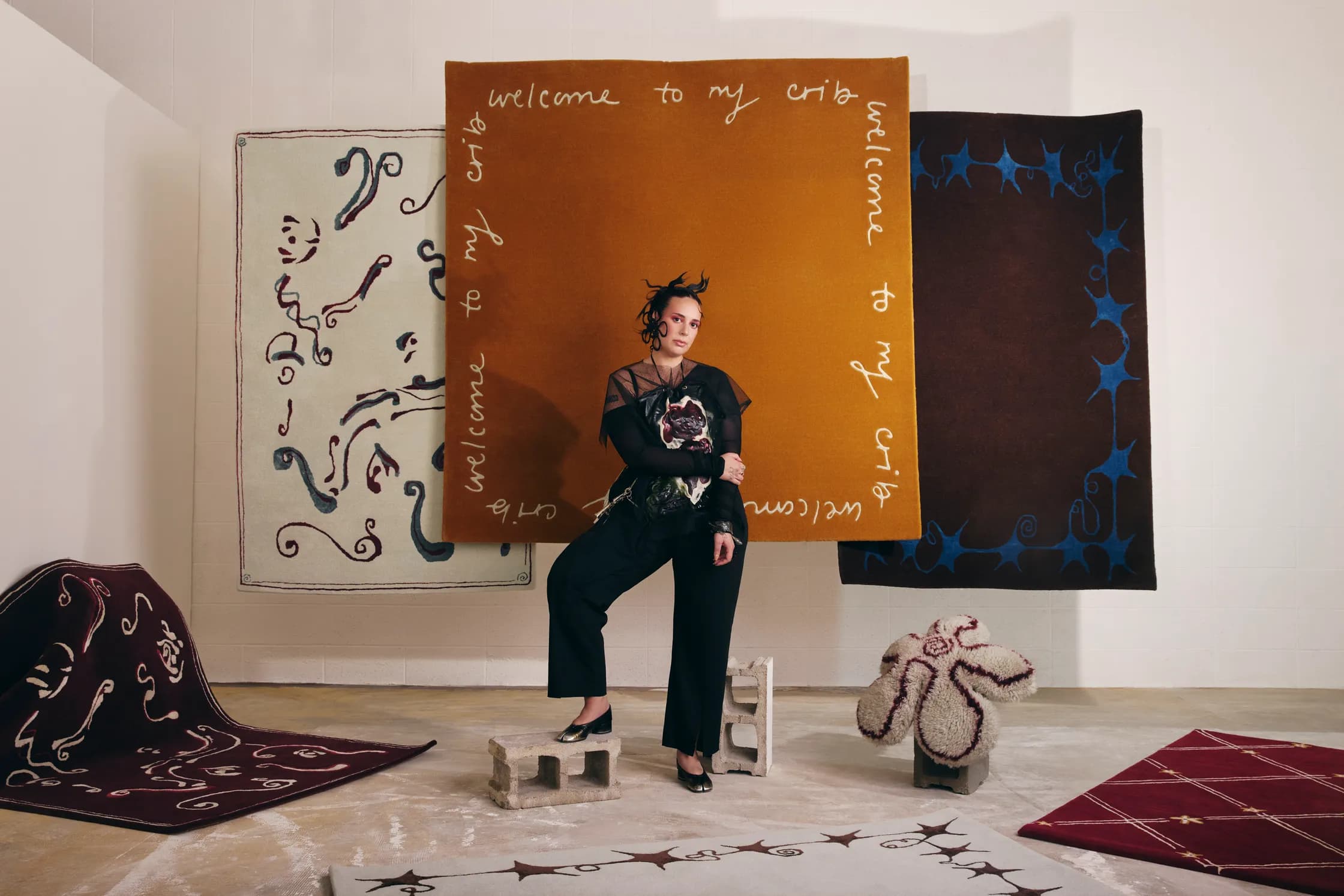
Canadian textile artist Rashelle Campbell has built a growing practice around colour, memory and the visual freedom of childhood—turning rugs, glassware and objects into something playful without making them feel disposable.
Based in Edmonton and from Bigstone Cree Nation in Wabasca, Campbell began making rugs during the pandemic after struggling to find pieces that matched what she imagined for her own home. What started as experimentation with a tufting gun quickly developed into a distinctive design language built around bold colour, soft forms and nostalgia.
From Personal Experiment to Design Practice
Campbell originally worked in PR and photography, but during the lockdown years her attention increasingly shifted toward interiors.
She began experimenting with rug making in 2020, creating pieces that felt closer to drawings or characters than conventional floor coverings. Early designs included flower-like forms in saturated oranges, pinks and greens.
After sharing them online, the response grew quickly. Her work eventually reached retailers including SSENSE, while her own label, Rashelle, expanded beyond rugs into a broader collection of home objects.
That trajectory reflects something happening across independent design more broadly.
Many of the most compelling new brands are emerging not from traditional furniture companies, but from artists who begin with a very specific visual idea and gradually expand it into objects for everyday life.
Designing From Childhood Memory
Campbell describes her childhood bedroom as an important reference point.
It represents a space where imagination could operate freely—a place associated with safety, comfort and creativity. That atmosphere continues to shape the way she approaches her work today.
The result is design that embraces visual pleasure without embarrassment.
Rather than removing colour in the pursuit of sophistication, Campbell uses it deliberately. Shapes are exaggerated. Patterns feel hand-drawn. Objects sometimes resemble toys, doodles or memories from early-2000s culture.
Yet the materials keep the work grounded.
Her rugs are produced using New Zealand wool, with some designs incorporating silk-bamboo detailing.
It is nostalgia translated through craft.
Heritage Without Predictability
Campbell's latest Homecoming collection also brings her Cree heritage more explicitly into the work.
The Swirly Star rug uses a border of cartoon-like stars, referencing the significance of stars within Cree culture. Campbell describes the connected stars as representing community and togetherness.
What makes the piece interesting is that heritage is not presented through a fixed or traditional visual language.
Instead, cultural references sit naturally alongside contemporary graphics, humour and pop culture.
This approach feels particularly relevant for a new generation of designers whose identities cannot be reduced to a single aesthetic category.
Tradition becomes something to work with rather than something to reproduce.
A Home Should Have Personality
Campbell's work also challenges the idea that serious interiors need to be restrained.
For years, much of contemporary interior imagery has been dominated by beige, stone, muted timber and highly controlled minimalism.
There is nothing inherently wrong with that language.
But when every home begins using the same palette, materials and furniture references, individuality starts to disappear.
Campbell offers almost the opposite proposition.
A rug can be bright pink.
A glass dish can look slightly strange.
A decorative object can make you smile.
The home does not have to behave like a gallery.
Fashion and Interiors Are Closer Than We Think
Campbell also sees a direct relationship between dressing yourself and decorating your surroundings.
For the campaign accompanying her latest collection, she placed herself in front of the camera wearing independent fashion labels alongside her own work. She described styling a home as emotionally similar to styling yourself.
That connection is becoming increasingly important.
Fashion, art and interiors are no longer operating as completely separate worlds.
The person interested in an unusual independent fashion label may also be looking for a handmade rug, an artist-produced lamp or a ceramic object that feels equally personal.
In both cases, the objective is the same:
to surround yourself with things that communicate something.
Beyond Rugs
Rashelle is already expanding into new categories.
Campbell has begun experimenting with glassware, including small jewellery dishes and sculptural ashtray-like objects whose irregularity is part of their appeal. Bath mats, cushions and clothing are also among the areas she is exploring.
The expansion makes sense because the strongest element of the brand is not one particular product.
It is the world around it.
Once a designer develops a sufficiently recognisable point of view, that language can move between textiles, furniture, jewellery, clothing and objects without losing its identity.
The Return of Joyful Design
Campbell describes her approach as giving nostalgia an adult interpretation.
That may be why the work feels so timely.
People are becoming more willing to reject the idea that adulthood requires visual restraint. Interiors can be sophisticated while still containing humour, colour and sentimentality.
A home can have beautiful furniture and a strange rug.
A sculptural glass object can sit beside something inherited.
A room can be serious in one corner and completely playful in another.
The most memorable interiors often contain exactly that kind of contradiction.
Rashelle Campbell's work is a reminder that good design does not always have to whisper.
Sometimes an object earns its place simply because it brings joy.